Three Mile Island accident
Jan 25, 2026
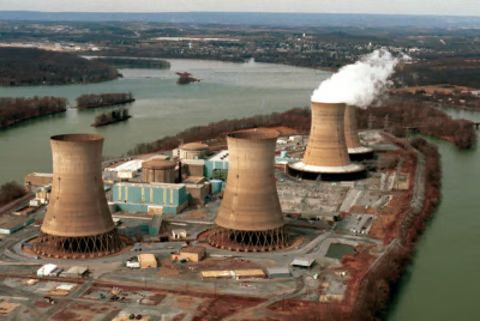
The Three Mile Island accident was a partial meltdown of the Three Mile Island, Unit 2 (TMI-2) reactor on the Susquehanna River in Londonderry Township, Pennsylvania, near the Pennsylvania capital of Harrisburg. It began at 4 a.m. on March 28, 1979, and released radioactive gases and radioactive iodine into the environment. It is the worst accident in U.S. commercial nuclear power plant history. On the seven-point International Nuclear Event Scale, it is rated Level 5 – Accident with Wider Consequences.
The accident began with failures in the non-nuclear secondary system followed by a stuck-open pilot-operated relief valve (PORV) in the primary system that allowed large amounts of nuclear reactor coolant to escape. The mechanical failures were compounded by the initial failure of plant operators to recognize the situation as a loss-of-coolant accident (LOCA). TMI training and procedures left operators and management ill-prepared for the deteriorating situation. During the event, these inadequacies were compounded by design flaws, including poor control design, the use of multiple similar alarms, and a failure of the equipment to clearly indicate coolant inventory level or the position of the stuck-open PORV.
The accident crystallized anti-nuclear safety concerns among activists and the general public, and led to new regulations for the nuclear industry. It accelerated the decline of efforts to build new reactors.
Anti-nuclear movement activists expressed worries about regional health effects from the accident. Some epidemiological studies analyzing the rate of cancer in and around the area since the accident did determine that there was a statistically significant increase in the rate of cancer, while other studies did not. Due to the nature of such studies, a causal connection linking the accident with cancer is difficult to prove.
Cleanup at TMI-2 started in August 1979 and officially ended in December 1993, with a total cost of about $1 billion (equivalent to $2 billion in 2022). TMI-1 was restarted 1985, then retired in 2019 due to operating losses. Its decommissioning is expected to be complete in 2079 at an estimated cost of $1.2 billion.
EntirelySAFE Supports Voices & Safety at Work
In the aftermath of such a heartbreaking incident, workers, families and safety professionals often find themselves wrestling with questions, concerns and the need to speak up. That's where EntirelySAFE can be a meaningful resource.
1. A Platform for Raising Concerns Confidentially
EntirelySAFE provides secure channels for employees to voice safety concerns they might otherwise be afraid to raise.
2. Centralizing Safety Communication
By collecting concerns and observations in one place, EntirelySAFE helps safety leaders identify patterns or recurring risks that might otherwise go unnoticed.
3. Support for Safety Professionals and Families
EntirelySAFE isn't just for workers. Safety professionals can use it to track the effectiveness of interventions.
4. Encouraging a Culture of Accountability and Care
The worst outcome in any workplace is the loss of life. EntirelySAFE's tools push organizations toward proactive safety cultures.
Country:United States
Date:Jan 25, 2026
Comments
Sign in to join the conversation